
Blog
The Art of Aging Series™ "Knowledge can't be bought – it has to be earned." - 8 July 2026

The Art of Aging™...ageing is Art! We know about the "ART OF AGING" for more then 30 years!
For more than 30 years, Crazyparts has been one of the leading specialists in authentic relic guitar parts and vintage-correct aging. Decades of hands-on experience, continuous development, and an uncompromising attention to detail have shaped our expertise.
True aging is not something you can buy – it is something you earn through years of experience. Understanding how vintage plastics, metals, and finishes naturally age requires knowledge that can only be gained through decades of working with original instruments and premium materials. Every part we produce reflects this passion, craftsmanship, and experience.
Crazyparts has been dedicated to the art of creating authentic aged guitar plastics and hardware. Long before relic guitars and vintage-correct replacement parts became popular, we were already developing and offering carefully aged components for collectors, professional guitar builders, restorers, and vintage enthusiasts around the world.
As one of the first companies worldwide to specialize in professionally aged replacement parts, we have continuously refined our techniques and expertise over decades. Every piece is the result of extensive experience, careful craftsmanship, and an in-depth understanding of the materials, finishes, and natural aging characteristics found on original vintage instruments.
Our Art of Aging™ Series is designed to recreate the subtle details that make genuine vintage guitars so special. Rather than using artificial or exaggerated relic effects, we focus on realistic wear patterns, authentic patina, and period-correct aging that blend naturally with both original vintage instruments and high-end custom builds.
Whether it's plastics, bridges, tailpieces, pickup covers, tuners, screws, or other hardware, every component is aged with the same attention to detail and commitment to authenticity that has defined Crazyparts for more than three decades.
Today, our aged parts are trusted by collectors, restorers, boutique guitar builders, and discerning musicians worldwide who demand the highest level of vintage accuracy and craftsmanship. The Art of Aging™ Series represents our passion, experience, and dedication to preserving the timeless character of the world's most iconic guitars.
Some generally informations about our guards - 9th July 2026

All of our pickguards are made with USA specs (unless mentioned on the product page). The USA sizing will generally fit Vintage Mexican and most Vintage Models as well as Custom Shop guitars. but in certain cases some Custom shop models and Pre-CBS sizings differ.
It should also be mentioned that Vintage Guitars were made by hand, meaning the alignment of the neck, body and bridge can vary slightly from one guitar to the next, and the pickguard was usually the last part to be installed. So even if the pickguards screw spacing is correct, the pickguard alignment itself may vary in any direction by 1-2mm. This is why most vintage Strat pickguards have different spacing round their bridges.
Keep this in mind when installing repro pickguards on any Vintage Guitar, you may need to slightly adjust the pickguard for an ideal fit. Most original pickguards are a tight fit anyways so this isn't often an issue visually, although if you do have some troubles here's some tips that may help:
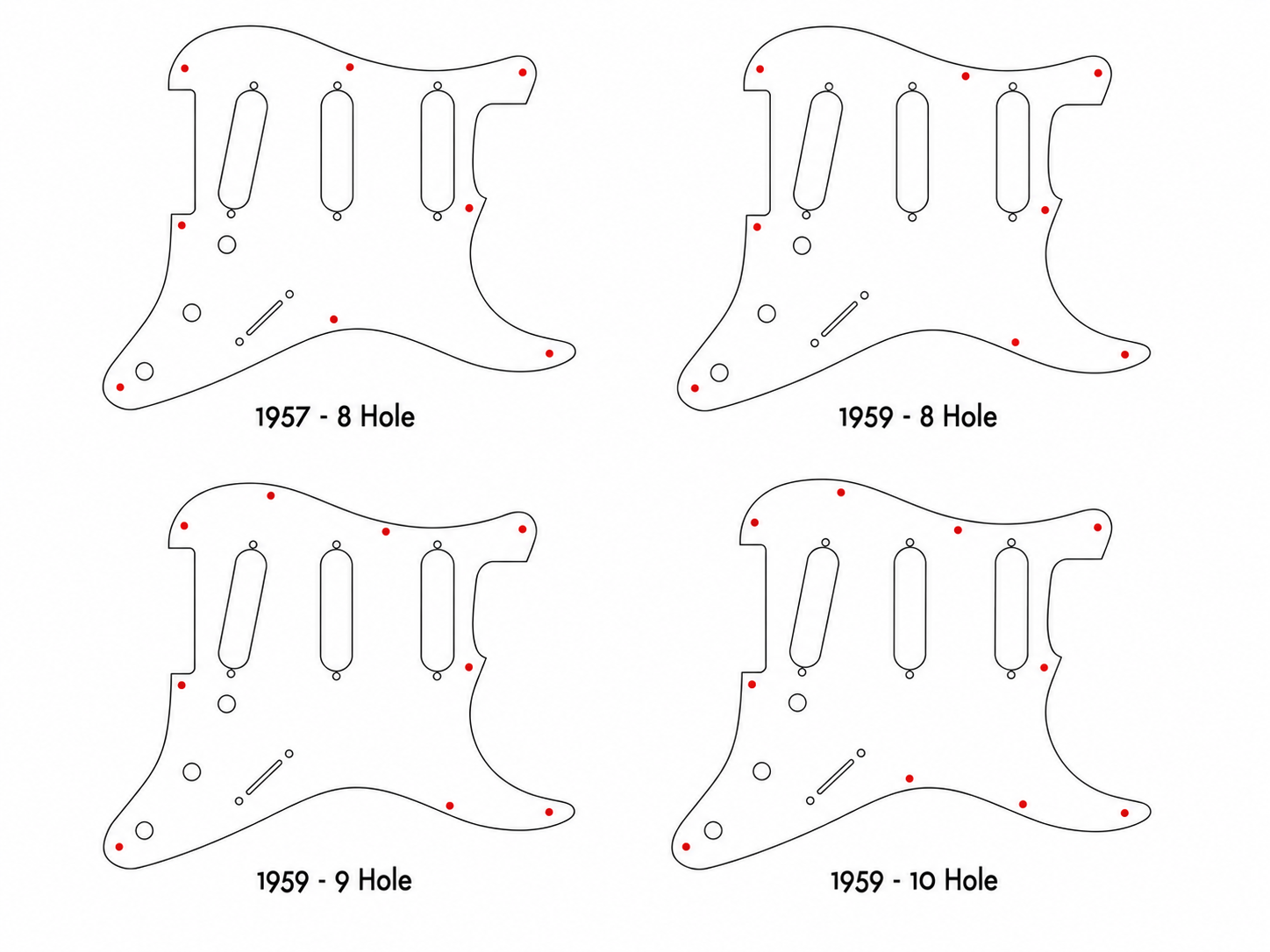
What is the difference in 1950's Holepattern?
The most common "1957 - 8 Hole" Pattern is also used for the 1 Ply White Guards from 1954 - 1959
Fender used 4 patterns for 1959. Two 8 Hole Styles ('57 or '59) as well as a 9 Hole and 10 Hole Patterns.
See details in the diagram the 1959 hole patterns progressed as the year went on.
• It started off with the typical 1957 8 Hole Pattern
• Then they repositioned the 2 holes on either side of the Middle Pickup, moving them upwards on both sides
• Then the holes remain in the same positions but they simply started adding additional holes for the 9 and 10 Hole Patterns
• The 9 Hole adds a screw to the left of the Bridge Pickup
• The 10 Hole adds a screw to the far right of the Middle Pickup
1962 versus 1964 Stratocaster® Pickguard Hole Patterns - 14 July 2026

1962 versus 1964 Stratocaster® Pickguard Hole Patterns
Both feature 11 holes with one small change. The 1962 has a screw placed almost directly between the left side of the neck and middle pickups, and the 1964 pattern simply moves that hole downwards by about half an inch.
This transition took place in mid-late 1963 but we refer to them as '62 and '64 patterns in order to avoid confusion.
We currently have offerings of the '62 and '64 pickguards in Vintage Correct colors - Mint, Parchment and Celluloid Tortoise Shell
We offer also 1962 & 1964 hole pattern LEFTY guards in Parchment and Greenish.